
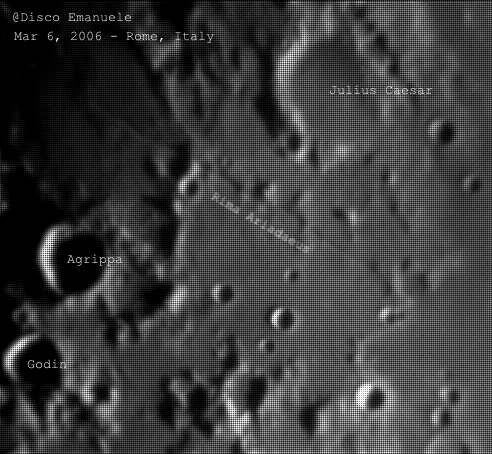
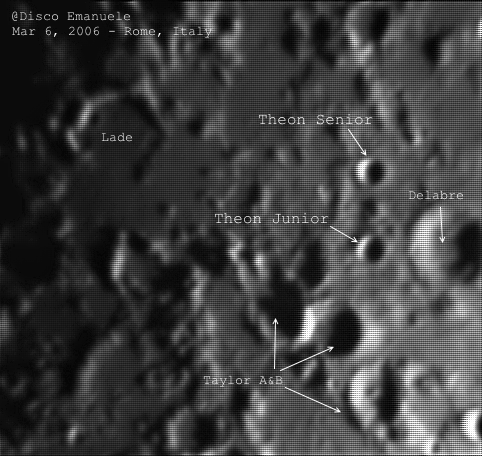
Some Moon processing of March 2006
The following shots have been taken long time ago, in 2006, probably with my Newton 114mm and Webcam Vesta Pro.
Unfortunately I didn’t save any information about the registration process.

M5 with SBIG ST-237 July, 2009 New Processing


M3 with SBIG ST-237 2009 New Processing


Abell56 in Aquila on July 27, 2009

Abell 56 Star Field with no sign of the nebula at the center.
This is a composition of 55 images taken with a Newton 200mm f10 and CCD SBIG ST-237.
Aligned and stacked with Iris
2012 DA14 – tracking with binocular
Really beautiful day was on February 15th, 2013.
I got up at 3 am and with my binocular 20×80 and tripod I went to a schoolyard near my home. I got ready for the event until 4 am, when finally I caught the little dot.
I started with star hopping from Minkar, Epsilon Corvi, and I went down until Xi Hydrae, where at 4 am I would have seen the asteroid.
The problem was that the altitude was really low, just 15 degree and a high building would have screwed up my day, so I decided to go up a little more until the building would not have been a problem.
It wasn’t really easy because the seen in Seoul, South Korea, is REALLY BAD! anyway, no moon, sky really clear from clouds, so was kind of perfect day. So I was able to put my view between Gamma and Beta Crateris, and at 4 hour and 18 minutes I saw this little dot of mag. +7.9 running really fast on the field of my binocular.
Really Exciting! I followed the asteroid for an hour, and was really a beautiful night. At around 4:40 it passed by a beautiful and rich field of stars between Crater, Virgo, Leo and Sextans constellation, and at 5 o’clock it passed by a rich field of faint NGC galaxies that unfortunately I was unable to see.
For the accurate position of the asteroid I used SkySafari Plus on my Ipod, where I was able to see in real time the exact position with a small error in Right Ascension but totally permissible.
However I wasn’t able to use my pc software, Cartes Du Ciel, to track the path of the asteroid, where on the contrary the ephemerides were totally wrong.
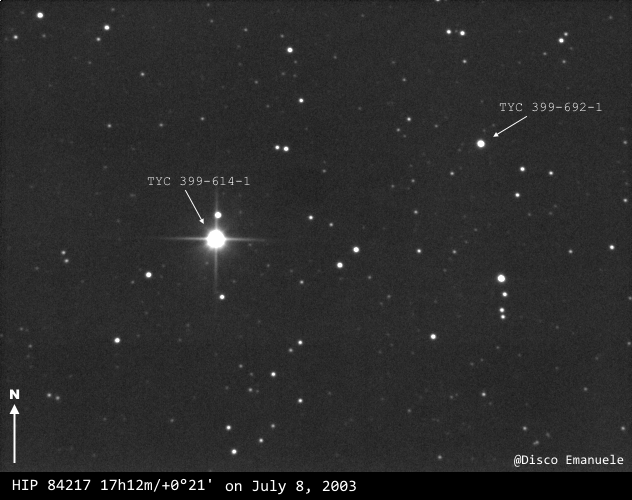
UCAC4 482-078944 – high proper motion
The first image is from the US Naval Observatory’s archive, the second is a composition of three images of 20 second each, with a Newton Ziel Galazy2 8′ with SBIG ST-247 camera at f/5.
The star has a proper motion in RA of -1.15″ per year, really fast!

Go to VizieR reference page
Go to Simbad reference page
Download source
This research has made use of the USNOFS Image and Catalogue Archive
operated by the United States Naval Observatory, Flagstaff Station
(http://www.nofs.navy.mil/data/fchpix/).
Messier 10 – 22 July, 2009, Rome
Messier 10 in Ophiuchus, Rome, Italy, 22 July 2009.
Details: Composition of 30 images ( 10 images for each channel RGB ). Every image has an exposure of 20 second at f/5, with telescope Newton Ziel Galaxy2 8′ on Skywatcher HEQ5 Syscan with SBIG ST-237 CCD camera.
RGB:

pseudo color:

Messier 12 – 22 July, 2009, Rome
Details: Composition of 30 images, 10R/10B/10G, exposure of 20s for each image, f/5, focal 1M. Newton Ziel Galaxy2 8′ on mount HEQ5 Syscan with camera SBIG ST-237.
Processed image:

In pseudo color:

Original fit image:
Messier 14 on 22 July, 2009, Rome
Details: Sum of 10 images for each channel RGB with 20s for each image, f/5, focal 1M. Newton Ziel Galaxy2 8′ on HEQ5 Syscan with camera Sbig ST-236.

Original fit file: